
All About Our 6 Week Sessions
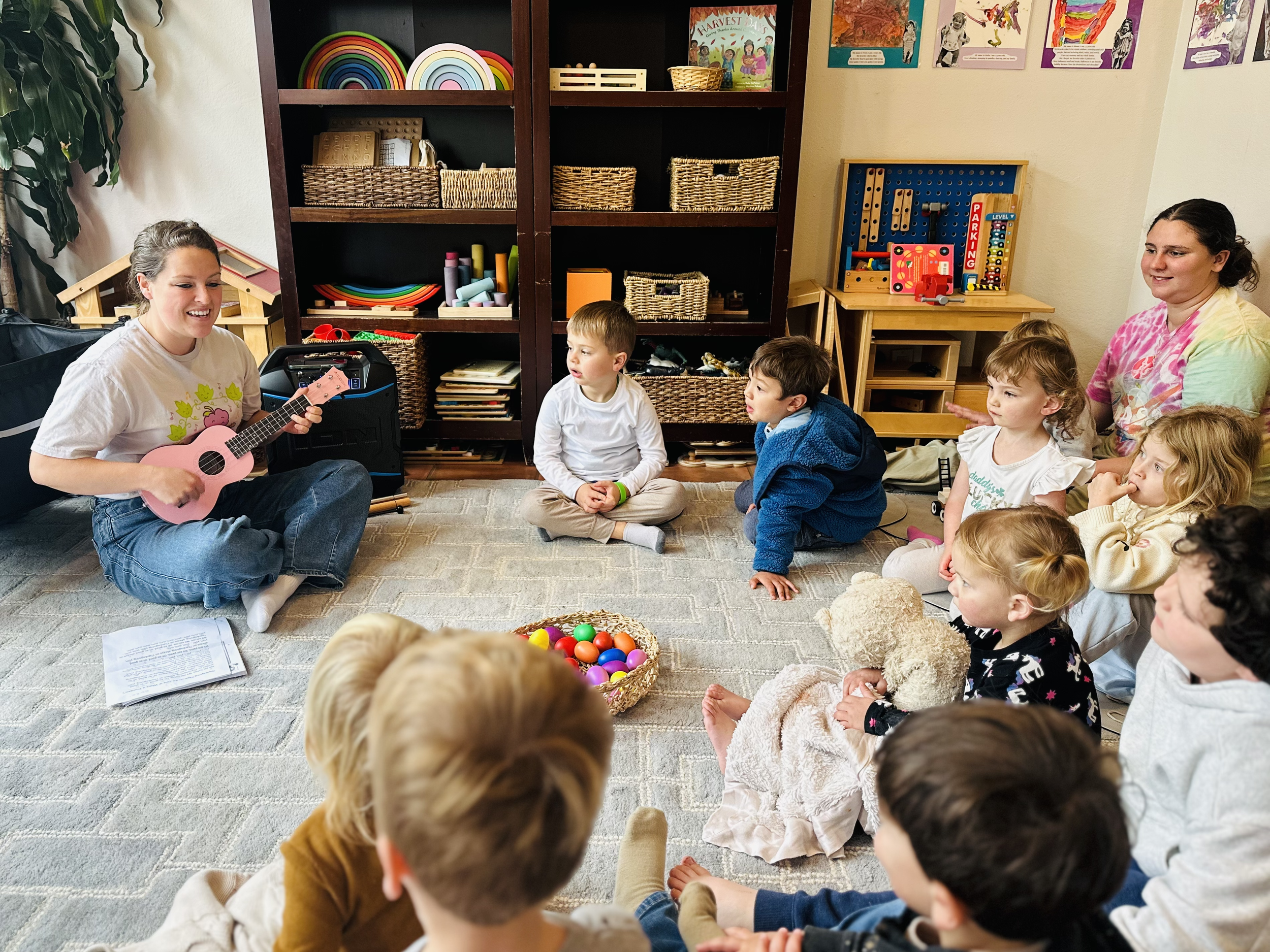
What Sets Us Apart
Each class follows the same brain-based rhythm:
Regulation
Connection
Skill building
Exploration
Calm closing
Your child learns skills in a COMMUNITY
This isn’t a big-box class where you’re a number. Your child is known here.
Same opening song
Familiar activities
Anticipation
Comfort
Repetition is not boring to kids.
It’s how safety forms.
Parents benefit too:
Mental break
Feeling like a “good parent”
Tools to use at home
A community
A peaceful weekly ritual
Offer:
1 simple take-home activity idea weekly
A recap sheet
A “song of the week”
A baby-friendly routine they can use at bedtime
BABY CLASS (0–18 months)
Musical Outcomes (End of 6 Weeks)
Babies will be able to:
Listen attentively to live singing and instrumental sounds
Respond to music with movement, facial expression, or vocal sounds
Explore sound vs. silence through pauses and cues
Experience steady beat through rocking, bouncing, and lap play
Begin vocal play (coos, babbles, pitch glides)
Musical skills developing:
Early sense of pulse
Pitch awareness through repeated melodies
Musical memory through familiar songs
Parent-Friendly Version
Babies build a foundation for musical listening, rhythm, and vocal development through live music, movement, and repetition.
1-Sentence Website Version
Babies experience steady beat, explore sound and silence, and begin responding vocally and physically to live music.
Ceremony when kid moves into next class
ribbons everyone and medal and graduation song
Mini performance/celebration
Parents want progression like:
Weeks 1–2: Comfort + safety
“My child gets used to the environment, teacher, and routine.”
Weeks 3–4: Engagement + growth
“My child starts participating without me prompting.”
Weeks 5–6: Independence + confidence
“My child leads activities, sings at home, and recognizes songs.”
This is how it should be described, even if the content is similar.
TODDLER CLASS (1.5–3 years)
Musical Outcomes (End of 6 Weeks)
Toddlers will be able to:
Keep a steady beat using hands, body, or simple instruments
Recognize and anticipate familiar songs and musical cues
Use their voice musically through singing fragments and vocal play
Play instruments with growing control and intention
Start and stop playing in response to music
Musical skills developing:
Beat awareness
Pitch exploration (high/low)
Dynamic contrast (loud/soft)
Tempo awareness (fast/slow)
Parent-Friendly Version
Toddlers develop rhythm, musical listening, and confidence using their voice and instruments through playful repetition.
1-Sentence Website Version
Toddlers build rhythm, recognize familiar songs, and begin singing and playing instruments with intention.
Emotional safety + a teacher their child bonds with
Everything we do is built around understanding your needs and helping you succeed—because when you thrive, so do we.
A Focus on Quality
We hold our work to high standards. We focus on sustainable results built on smart strategy and real insight.
PRESCHOOL / PRE-K CLASS (3–5 years)
Musical Outcomes (End of 6 Weeks)
Children will be able to:
Keep a steady beat independently
Echo simple rhythmic and melodic patterns
Sing short phrases on pitch
Adjust playing based on tempo and dynamics
Listen for cues and respond musically in a group
Musical skills developing:
Rhythmic accuracy
Pitch matching
Musical memory
Ensemble awareness
Parent-Friendly Version
Preschoolers strengthen real musical skills—rhythm, singing, listening, and group music-making—through engaging, age-appropriate activities.
1-Sentence Website Version
Preschoolers develop strong rhythm, singing skills, and musical listening while making music together as a group.
Optional: Super-Short Comparison (great for a graphic)
Babies: Listening, movement, vocal play
Toddlers: Beat, song recognition, early singing
Preschool: Rhythm accuracy, pitch matching, ensemble skills
Ceremony when kid moves into next class
Ring ribbons everyone and medal and graduation eintsong
certificate
Reliability You Can Count On
We follow through, meet deadlines, and show up when it matters. Consistency is part of our promise.
Proven Process, Flexible Execution
We bring structure where it counts and adaptability where it matters. Our methods are clear, but always responsive.
Our Packages
Rhythm & Beat Awareness
Kids learn to:
Feel a steady beat in their body
Move to music intentionally
Start and stop with musical cues
Recognize fast vs slow, loud vs quiet
This is the foundation of:
Music timing
Math readiness
Attention control
You teach this through:
Clapping
Shakers
Bouncing
Movement games
Repetition of the same songs
2.
Pitch Awareness & Singing Skills
Kids learn to:
Match pitch (even if imperfectly)
Explore high vs low sounds
Use their voice intentionally
Build confidence singing out loud
This is the foundation of:
Melody
Musical accuracy
Vocal confidence
Language development
You teach this through:
Call-and-response
Simple melodic patterns
Repeated songs
Modeling (not correcting)
3.
Musical Patterns & Structure
Kids learn:
Music has patterns
Songs repeat
There’s a beginning, middle, and end
Certain cues mean “now we play” or “now we listen”
This is the foundation of:
Music theory
Memory
Executive function
Classroom readiness
You teach this through:
Predictable routines
Repeating songs over weeks
Using the same song with new elements
Consistent transitions
4.
Listening & Auditory Discrimination
Kids learn to:
Listen for cues
Wait for their turn
Notice changes in sound
Pause when the music stops
This is the foundation of:
Self-regulation
Focus
Following directions
Ensemble skills (playing together)
You teach this through:
Stop/go songs
Quiet/loud contrasts
Instrument pauses
Guided listening moments
5.
Instrument Technique (Age-Appropriate)
Kids learn:
How to hold instruments
How to play them intentionally (not just shake)
That instruments have different sounds and roles
This is the foundation of:
Respect for instruments
Early technique
Musical intention
You teach this through:
Limiting instruments per class
Modeling correct use
Letting kids explore within structure
6.
Self-Expression & Musical Confidence
Kids learn:
Their voice matters
Their movement is welcome
There’s no “wrong” way to participate
Music is a safe place to express emotions
This is the foundation of:
Confidence
Creativity
Emotional intelligence
Love of music
You teach this through:
Non-corrective guidance
Choice within structure
Celebrating participation, not performance
The magic part parents feel (but don’t name)
You are also teaching:
Emotional regulation
Secure attachment (especially for babies)
Turn-taking
Group participation
Social awareness
But music is the vehicle, not the add-on.
Let’s Work Together
If you're interested in working with us, complete the form with a few details about your project. We'll review your message and get back to you within 48 hours.